

Digital Product Passport 2027: What Retailers Need to Know
Digital Product Passport 2027: Battery passports become mandatory on February 18, 2027 — textiles and steel follow. What retailers need to know about the DPP, deadlines, and preparation.
EU Regulation · ESPR
The digitalProduct Passport isto retail 2027
Battery passports become mandatory on February 18, 2027 — textiles, steel and electronics follow. What retailers need to know now.
The passport follows the product through the supply chain — all the way into your shop.
A forklift dealer calls his battery manufacturer: "You're sending me a what starting in February?" A data passport. Digital. One per battery. What sounds like science fiction is already on the calendar: On February 18, 2027, the battery passport becomes mandatory — the first binding digital product passport in the EU. And it is only the beginning of a wave that will reach textiles, electronics, and furniture by 2030, covering all of retail. The parallels to e-invoicing are hard to miss: there, too, many waited until the deadlines got teeth. After e-invoicing and AI labeling, the product passport is the next regulation reaching retail — this article explains what the DPP is, which deadlines are fixed, and what retailers should do now.
What is the Digital Product Passport (DPP)?
In short: The digital product passport is an electronic data sheet that the EU is making mandatory for more and more products — covering origin, materials, repair, recycling, and environmental properties, accessible via a QR code on the product. The legal basis is the Ecodesign Regulation ESPR (EU) 2024/1781; the obligation arrives step by step per product group, starting with batteries in 2027. Anyone selling products will need to make the passport data accessible in their online shop.
Behind the abbreviation DPP (Digital Product Passport) is a simple idea: every product gets a digital twin that applies across its entire life cycle — from the factory through retail to repair and recycling. The passport is not a PDF in an attachment but a structured data set in an EU registry (the "Product Registry"), accessible via a QR code, an RFID chip, or a link. What goes inside is determined by the delegated legal act of each product group — typically:
- Manufacturer and country of origin, unique product identifier
- Material and substance data (such as recycled content, chemicals)
- Repair and spare parts information
- Recycling and disposal instructions
- Environmental declarations and proof of conformity
Important for context: the passport follows the product. It travels with it through the supply chain — from the manufacturer via importers and wholesalers to the retailer who ultimately offers the product. And that is exactly why the obligation will reach retail sooner or later.
Which deadlines are already fixed?
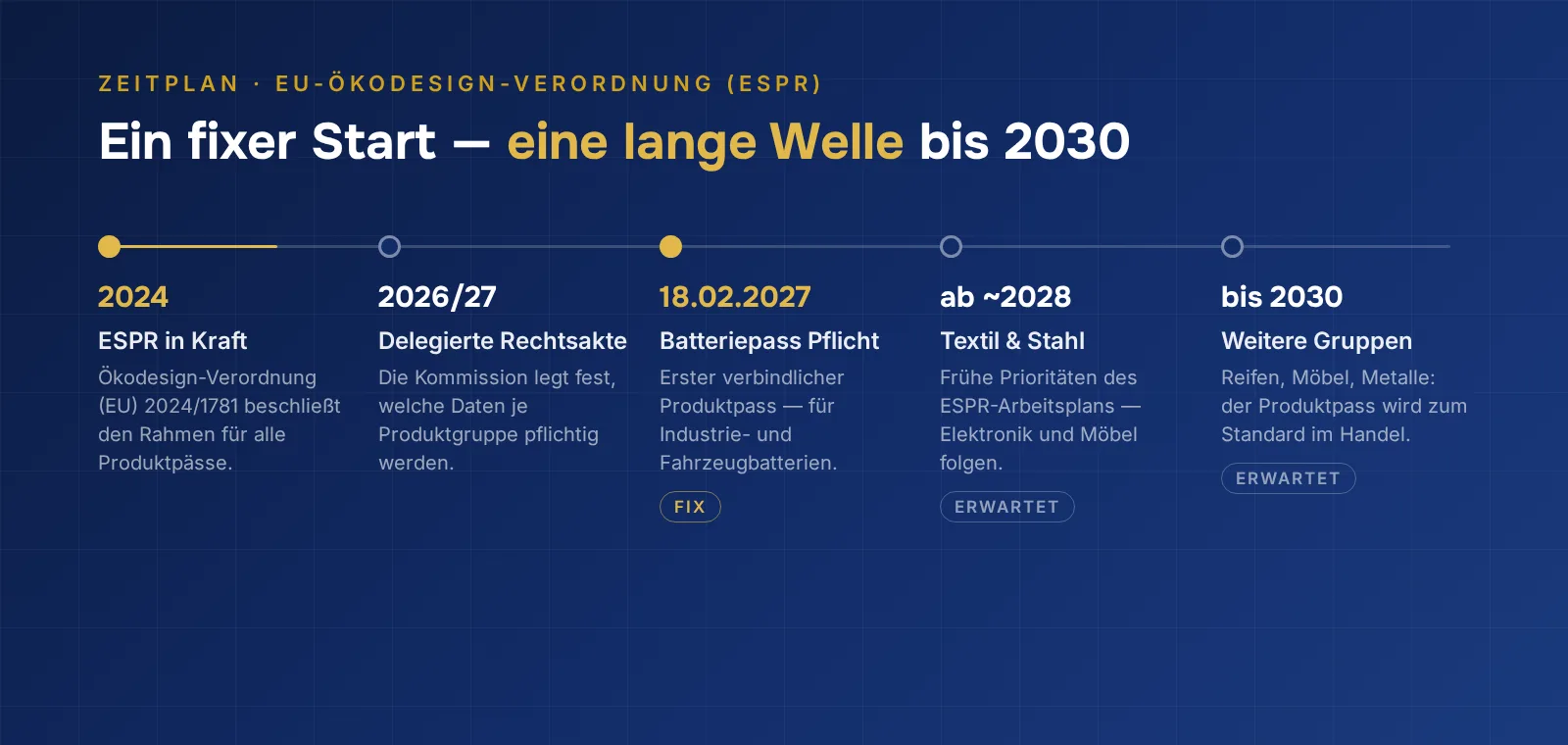
In short: February 18, 2027 is fixed for batteries (battery passport under EU Regulation 2023/1542) — after that, product-group-specific deadlines follow via delegated acts, with textiles, iron & steel, and electronics as early priorities, realistically from 2028. There is no everything-in-2027 date.
The EU is pursuing two tracks. The battery passport is based on its own, already adopted regulation, making it the first DPP with a hard deadline: from 18.02.2027, every industrial or vehicle battery placed on the EU market must have a data passport. Anyone selling batteries, e-bike packs, or forklift drives today has the shortest path to the obligation.
Everything else runs through the ESPR and its delegated acts — and they are slipping. The Commission had scheduled the first acts (originally planned for late 2025) for 2026; true to the delay pattern of the battery regulation, the industry now expects adoption from mid/late 2026 and conformity obligations realistically from 2028. The ESPR working plan 2025–2030 names the order: iron & steel and textiles first, then furniture, tires, electronics, and more. For retailers, this means: no reason to panic — but no reason to take the topic off the radar either. Anyone who waits with data collection until "the deadline is here" builds the same time pressure that caused red faces during the 2024/25 e-invoicing chaos.
What the product passport demands from retailers
The passport itself is created by the manufacturer (for imported goods: the importer). Retail's main obligation is passing it on: anyone offering a passport-required product must make the data accessible — in stationary retail via the QR code on the product, in the online shop via a visible link on the product page ("product passport" next to datasheet and delivery time). And e-commerce is explicitly included: in B2B shops too, passport data belongs on the product sheet as soon as the product group becomes subject to the obligation.
Four tasks await retailers:
- Demand the data. The passport data set must come from the manufacturer or supplier. Retailers need to challenge their suppliers — similar to the transition to e-invoicing, except this time product data flows instead of invoice data. Anyone reselling articles without passport data makes themselves vulnerable.
- Integrate technically. The link or QR code must go into the product page. That is not rocket science, but it takes a plan for how the data gets into your shop system — manually, via an interface, or through the supplier feed.
- Returns and used goods. Returns, B-stock, and used products manufactured after the deadline keep their passport obligation when resold.
- Be visible. In the online shop, accessibility is intended from the start of the product group's obligation — in B2B shops too. The concrete scope is regulated by the respective delegated act.
The good news for B2B retailers: the structure mirrors tasks many have already done for e-invoicing — demanding data from suppliers, bringing it into the system, filing it procedurally. Anyone who documented their e-invoicing project cleanly now has a template.
How retailers can prepare now — in three steps
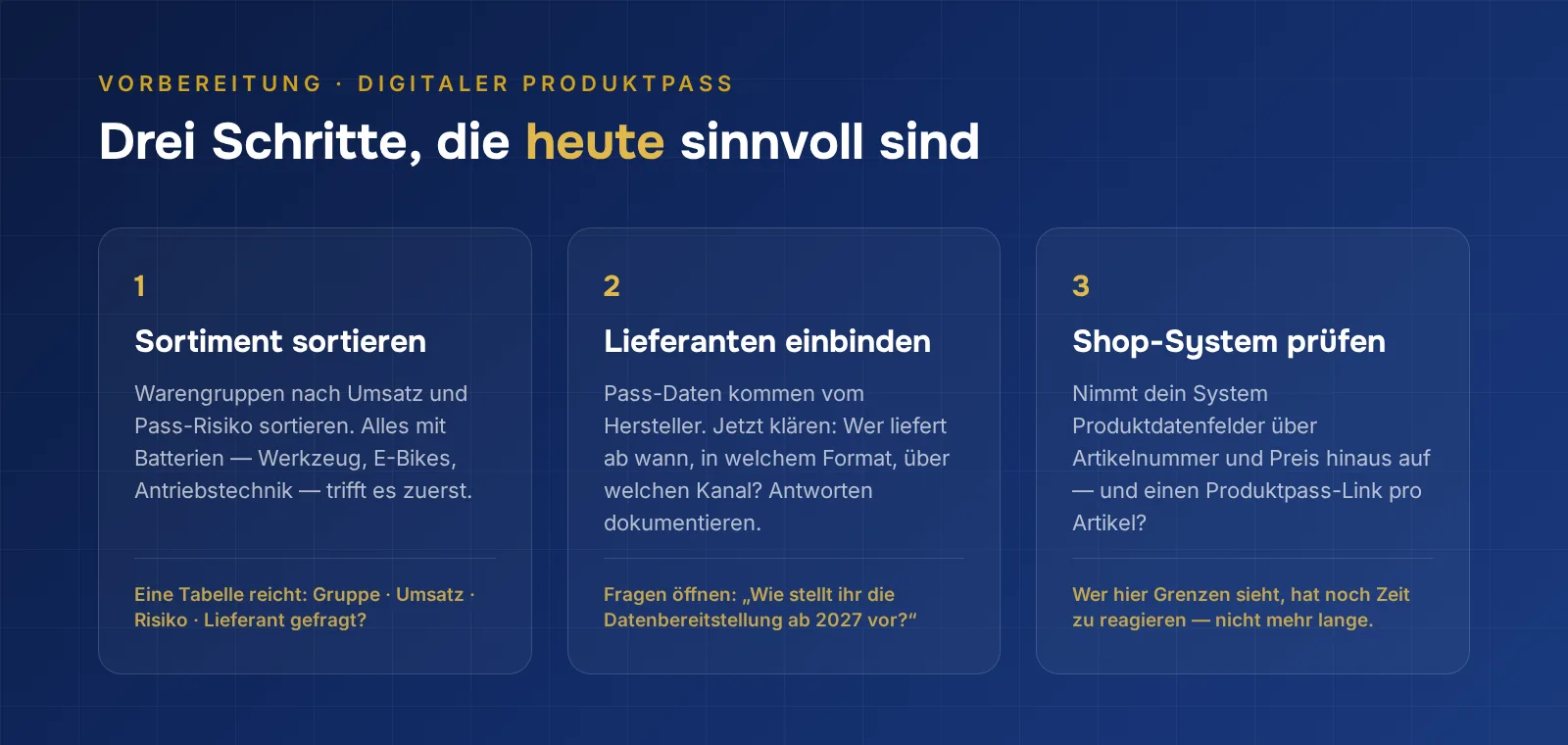
Anyone who waits until 2027 for the "passport for products" to become a knockout criterion at goods reception has lost. Three steps that make sense today — without an inflated budget:
1. Sort the assortment by risk. Which product groups make up 40, 60, 80 percent of your revenue? Where do batteries already appear (tools, e-bikes, drive technology)? These assortments will feel the passport first. A simple table is enough: product group · revenue share · passport relevance (high/medium/low) · supplier talked yes/no.
2. Involve suppliers. Next meeting with the top suppliers of your risk product groups: who delivers passport data from when, in which format, via which channel? Experience says it will be a mix of PDF, CSV, and API — that's fine as long as you know it. Document the answers so you don't start from zero in 2027.
Ping suppliers, don't interrogate them. No manufacturer has a finished DPP process for you today. Don't ask "Do you have the DPP yet?" but "How do you envision providing the data from 2027?" — that opens conversations instead of closing them.
3. Check your shop system. Can your shop system absorb product data fields beyond article number and price — origin, materials, recycling, for example? And can you place a "product passport" link per article? If yes: good. If no: you still have time, but you should know where you stand. At Kontorly, we think this through with you — a shop system that treats product data structures not just as an obligation but as a sales argument helps you surf this wave instead of swallowing it. If your current system already showed its limits with AI labeling, that's a good early indicator.
FAQ — questions retailers ask us
As a retailer, do I have to create a product passport myself?
As a rule, no. The passport is created and managed by the manufacturer or importer. Your obligation is accessibility: QR code on the product or link on the product page. Only if you are the manufacturer or importer yourself (e.g., own brands or imports) do you create the passport.
Does the product passport apply to B2B shops too, or only to consumer sales?
Both. The passport follows the product through the supply chain — once the respective product group becomes subject to the obligation, the accessibility requirement also applies to B2B shops. In business-to-business commerce, your business customers additionally need the passport data for their own onward passing.
What happens if I ignore the obligation?
The ESPR enables market surveillance and sanctions — from prohibiting the placing on the market to fines designed by each member state. More practically relevant: listing articles without passport data will be like sending paper invoices after the e-invoicing mandate — the market regulates that faster than any authority.
From when exactly does this apply to my assortment?
As soon as the delegated act for your product group is in force and the transition period expires. For batteries: 18.02.2027. For everything else, the rule of thumb is: deadline = adoption of the act + approx. 18 months. So: keep an eye on the Commission's act tracker once your product group is up.
Does the DPP bring benefits — or only costs?
Honest answer: short-term effort, long-term structure. Once the passport data is cleanly in your shop, you can sell with it — origin information and repair details become an argument in B2B, for example when business customers must prove sustainability. The passport also forces a data hygiene that saves money on returns, complaints, and used-goods sales.
If you'd rather learn about regulatory deadlines a year ahead than a month after — that's exactly why we write here regularly. Kontorly is a German B2B e-commerce platform (SaaS) for online shops with tiered pricing, customer groups, and direct orders from business customers. Made in Germany, from Hamburg. New articles on B2B commerce and regulation are available via our newsletter — concise, contextualized, without fearmongering.
Kontorly Editorial Team
This article was written by the Kontorly editorial team. We cover B2B commerce, shop systems and digital processes — editorially independent, with insights from building our platform every day.
Ready to launch your B2B shop?
Kontorly brings tiered pricing, customer groups and e-invoices out-of-the-box. Set up in minutes.
Start for free