

Switching to E-Invoices: A Roadmap for Running Shops
Switching to e-invoices by 2027: deadline check, analyzing your shop's current state, and a 4-step migration path — for established shops, not for new founders.
B2B Commerce · Regulation
e-invoices switch:Your roadmap for the running shop
Deadline check, status analysis, and a four-step migration — without stopping daily operations.
You are here
2025
Receiving obligation applies
2027
Issuing obligation begins
2028
No exceptions, every size
Your shop is running. Customers place orders, invoices go out — as PDFs from your shop system, automatically, at 11:47 pm, without anyone thinking about it. That's exactly the problem: this convenience ends in 2027, and switching over while business is running is different from building something new. You're not breaking new ground — you're changing a wheel at 140 km/h. This article is the roadmap: deadlines, a status check, and a four-step migration path, written for merchants with an established business, not for founders starting from scratch.
When do you really have to switch to e-invoices?
By December 31, 2026 you must be able to issue e-invoices — until then, the general transition period applies, under which you may still send paper invoices and simple PDFs. Smaller issuers (prior-year revenue up to €800,000) have longer, until the end of 2027; from January 1, 2028, it's over for everyone. An e-invoice is not a PDF with a folder icon on it, but a structured document (XRechnung or ZUGFeRD) whose mandatory information is fully machine-readable — Germany's Federal Ministry of Finance (BMF) made that explicitly clear again in 2026. The switch in an established shop runs in four steps: check deadlines, analyze the current state, define the target format and tooling, then migrate and test piece by piece.
First, the deadlines — they set your pace
The key data in a table, because precision matters here:
| Date | What applies |
|---|---|
| Since January 1, 2025 | Obligation to receive: You must be able to process incoming e-invoices |
| Until December 31, 2026 | General transition period: paper invoices and simple PDFs allowed for issuers |
| Until December 31, 2027 | Extended transition period only for issuers with up to €800,000 prior-year revenue |
| From January 1, 2028 | Obligation to issue for everyone — without gaps, B2B and B2C alike |
Two details that are commonly misunderstood: First, the €800,000 threshold refers to your total prior-year revenue — not the value of individual invoices and not the recipient's revenue. Second, from 2028 the obligation covers every domestic invoice without exception, including those to private customers. Anyone hoping for a B2C exemption like the one some other EU countries have is waiting in vain in Germany.
The complete deadlines and legal situation are broken down in E-Invoice Mandate 2027: All Deadlines at a Glance — this article is about the switch itself.
Step 1: Status check — which camp are you in?
Our conversations with merchants reveal three typical starting points:
Camp 1 — "Excel plus PDF": Invoices run through accounting software or the tax advisor; the shop itself doesn't send invoices at all, just order confirmations. Then the shop side is relaxed, and the switch happens in accounting. Ask your tax advisor whether their software can output XRechnung or ZUGFeRD in 2027 — most modern solutions can, but "most" is not an answer you want to have in December 2026.
Camp 2 — "the shop sends PDFs": Your shop system generates invoices automatically from the order. That's the most common — and trickiest — constellation, because processes are affected that nobody touches anymore. The PDF is as much a part of the daily routine as the empty coffee machine at closing time.
Camp 3 — "paper at the edges": Part of the invoicing happens outside the system — phone orders settled by email with an attached spreadsheet. These shadow processes are the real reason why migrations in established businesses fail: nobody knows in advance where invoices are actually created.

The status check takes an afternoon and answers three questions: Where do invoices originate today? Where is the mandatory information stored — in the shop system, in accounting, in people's heads? And: who changes anything when you add a new customer, a new product, a new tax rate?
Common question: Do I really have to act now — isn't the deadline in 2027?
For issuing, the transition period applies, yes. But the obligation to receive has applied since 2025, and SCM customers (large corporates) are actively demanding e-invoices today. Anyone starting preparation in 2026 migrates calmly. Anyone waiting until 2027 migrates under time pressure, together with everyone else — including all the consultants and agencies.
Step 2: Cleaning up master data — the underestimated part
Before any format is switched, the data has to be clean. An e-invoice is machine-readable — and machines don't forgive the sloppiness a human reader skips over with common sense.
In practice that means: maintain customer records (every invoice address needs complete, correct details — no "c/o same as always"), set tax rates up properly, make article and service descriptions unambiguous. And observe the tightened 2026 BMF clarification: all mandatory information must be fully contained in the structured part of the e-invoice. A PDF attachment with the missing details is not enough — the XML itself must be complete (source: BMF FAQ on e-invoicing, updated 2026 edition).
This is where the real effort of the switch lies, and it's chemically related to everyday shop life: maintaining master data has always been the task everyone pushed aside because nobody sees it. Now it becomes visible — in the best case as a one-time push, in the worst case as months of backlog processing.
Step 3: Define target format and tooling
Two formats meet the requirements, and the choice depends on your customers:
| XRechnung | ZUGFeRD | |
|---|---|---|
| Principle | Pure XML | PDF with embedded XML |
| Demanded by | Public sector, corporations with SCM | Private-sector economy |
| Human-readable | No | Yes — the PDF stays a PDF |
If you mostly invoice business customers and mid-sized companies, ZUGFeRD will be your daily reality; the detailed pitfalls of both formats are covered in ZUGFeRD vs. XRechnung: The Difference, Simply Explained.
More interesting is the tooling question. Fundamentally, three paths are open, and established shops do tell them apart:
- Extend accounting: Pass invoice data from the shop as a record; the e-invoice is created in the accounting software. Proven when order volume is manageable and the interface exists.
- Insert a converter: The existing PDF pipeline stays; a service converts to ZUGFeRD. Works as a transition — fragile in the long run, because an extra layer remains error-prone (and the conversion is only as good as the master data from step 2).
- The shop system issues e-invoices itself: The invoice is created where the order originates — without an intermediate layer. Modern shop systems now include this natively; Kontorly generates e-invoices directly from the order process, without accounting getting in the way.
Path 3 is not a random reference, but the consequence of what established shops experience on paths 1 and 2: every additional layer means another place where master data is maintained twice, formats break, and errors become reportable. If you were planning to consolidate your shop stack anyway, you can take the e-invoice switch as the occasion — the total costs of the different paths are compared in What Does a B2B Online Shop Cost?.
Step 4: Migrate, test, observe
The actual switch in an established shop is a relay race, not a big bang:
- Parallel operation. Old and new invoicing run side by side at first. Standard customers first, problem customers (abroad, special terms, exports without VAT) deliberately later.
- Inform customers. A short note with the first e-invoice is enough: "From now on you'll receive your invoices in structured form — nothing changes for you when reading them." Few business customers react; those who do often have requirements of their own that you'll learn about now.
- Watch the return channel. How do the recipient systems react? Do e-invoices bounce back as undeliverable or disappear into spam filters? The first weeks of parallel operation show you.
- Document. When did you switch, which formats, which exceptions? For a potential tax audit, the migration process itself is part of the records.
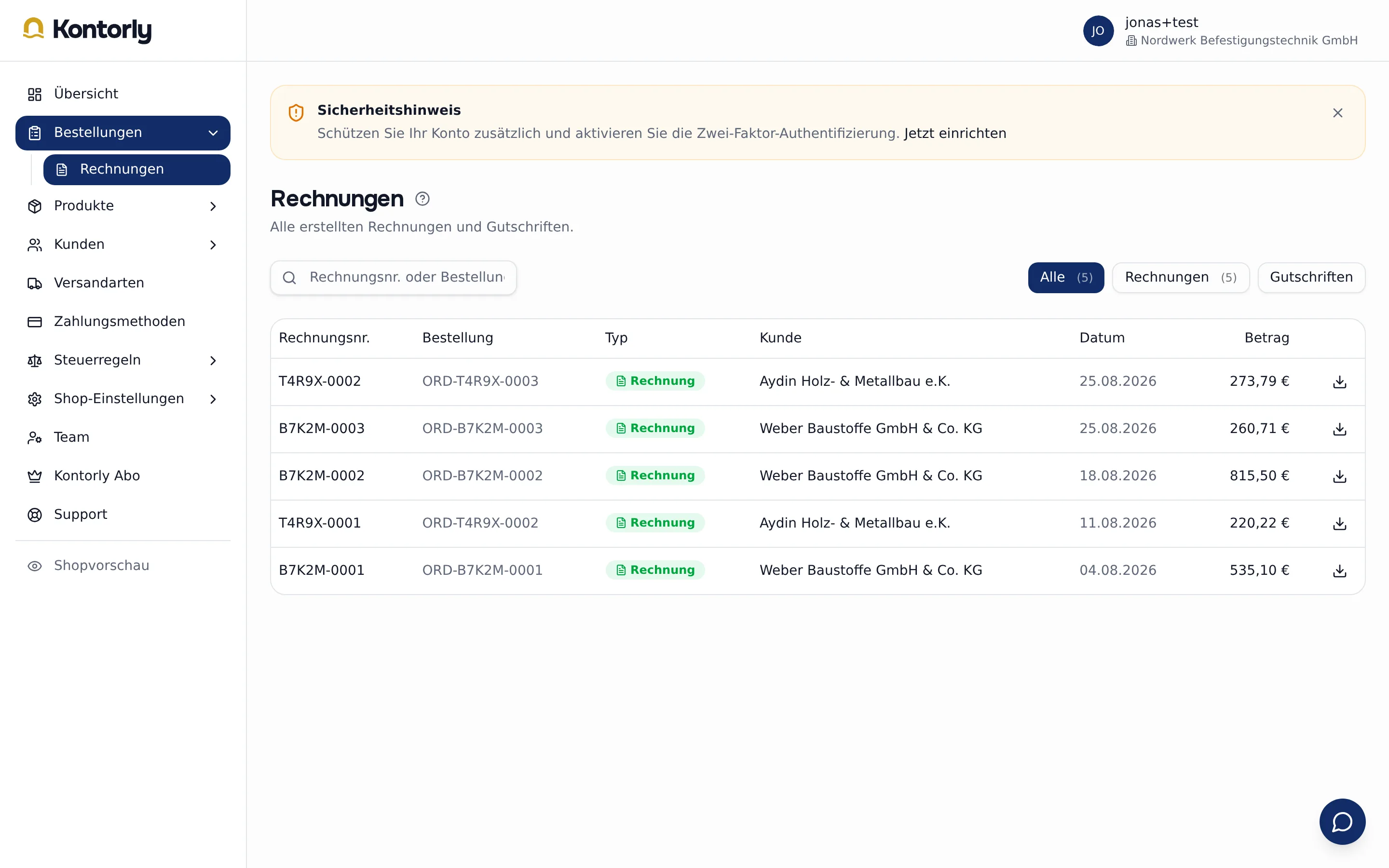
Common question: What happens to old PDF invoices from the transition period?
They remain valid — the transition period exists precisely for that. But: retention obligations apply to e-invoices just as they do to paper invoices, and in the original format. Anyone converting XML invoices to PDF to "file them nicely" is altering the original — the BMF FAQ has rules for that too, which you should know before the archive folder starts to thicken.
The checklist for established shops
For ticking off — not as an object of awe, but as the minimum:
- Own deadline determined (€800,000 threshold checked, prior-year revenue documented)
- Invoice sources inventoried — including the shadow processes
- Master data cleaned, mandatory information complete in the XML per BMF
- Target format chosen (ZUGFeRD, XRechnung, or both by customer group)
- Parallel operation planned with a defined test customer circle
- Retention clarified — original format stays intact
The right moment is one quarter before your deadline
Not earlier — anyone building in 2026 for a 2028 deadline is building against outdated assumptions. Not later — because the last mile always takes longer than planned. As a rule of thumb from conversations with merchants: one quarter of lead time between a functioning test run and the binding switch. That's the buffer in which the things no roadmap predicts will happen.
If you want to see what an e-invoice pipeline looks like when it originates directly in the order process — without converters, without double structures — take a look at a Kontorly demo. Kontorly is a German B2B e-commerce platform (SaaS) for online shops with tiered pricing, customer groups, and direct ordering by business customers — e-invoices included. Made in Germany, from Hamburg.
Kontorly Editorial Team
This article was written by the Kontorly editorial team. We cover B2B commerce, shop systems and digital processes — editorially independent, with insights from building our platform every day.
Ready to launch your B2B shop?
Kontorly brings tiered pricing, customer groups and e-invoices out-of-the-box. Set up in minutes.
Start for free