

AI Labeling Obligations: What B2B Shops Must Disclose Now
AI labelling under Art. 50 of the EU AI Act applies since August 2, 2026. What B2B shops really must label for chatbots, AI images, and product texts.
EU AI Act · Article 50
AI labeling:what B2B shops reallymust label
Article 50 applies since August 2, 2026 — but far from everything in your shop is covered. This article sorts the three cases that count.
Product texts and icons stay label-free — the worry about a content flood is unfounded.
A customer writes to your shop's chat at 10:40 pm: "Is item 4711 still available by Friday?" The answer arrives within seconds — friendly, correct, from the AI. Does he need to know that? Yes, since August 2, 2026. On that day, the transparency obligations of the EU AI Act entered into force — and they don't just affect tech corporations, but every B2B shop with a chatbot, AI images, or AI-assisted content. The good news upfront: for most shops, the effort is smaller than the headlines suggest. This article sorts out what really needs to be labelled — and what doesn't.
What has applied since August 2, 2026?
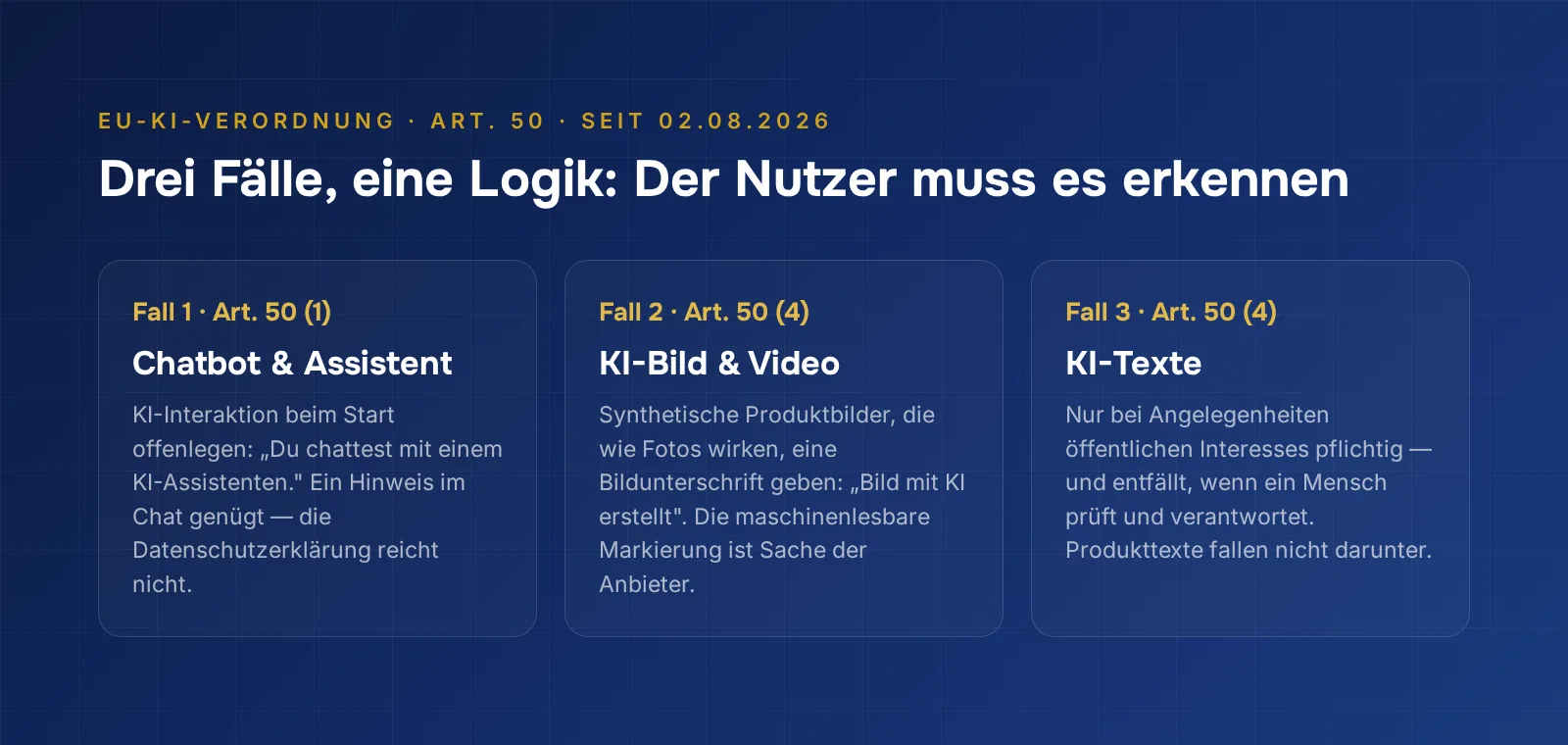
In short: Article 50 of the AI Act requires that your users can recognise when they are interacting with an AI or facing AI-generated content. Three cases are relevant for shops: chatbots and voice assistants, AI-generated images and videos that could appear real, and AI texts on matters of public interest. Regular product descriptions are explicitly not covered.
The European Commission has published guidelines on this, and the IHK Cologne has translated them into practical cases. The core logic is always the same: it's about transparency towards the human on the other side — not about banning AI. Whoever knows the three cases has the obligation under control.
Chatbots and AI assistants: the clearest obligation
The most unambiguous rule concerns every interaction: if a user does not recognise by themselves that they are writing or speaking with an AI, you must disclose it. The notice must appear directly at the start of the conversation — in the chat window itself. One sentence is enough:
- "You are chatting with an AI assistant."
- "This chat is run by an AI. For complex questions, we'll connect you with a human."
The same applies to AI responses by email, voice assistants on the phone, or digital avatars advising customers.
Common question: Is a notice in the privacy policy enough?
No. The labelling must be immediately visible to the user when interacting with the AI. A general transparency notice in the imprint or privacy policy does not fulfil the obligation — the European Commission made that clear in its guidelines.
Not subject to labelling, on the other hand, is AI use the customer never notices: a service employee having answers drafted by AI, or an AI triggering product recommendations or price updates in the background. Here, the customer interacts with a human or with your shop — not with the AI.
AI images in the shop: when you must label
The second most important case for merchants: images, audio, or videos that AI has generated or manipulated so they could appear real. The IHK explicitly names an example from retail: synthetic product presentations — product images not based on real photos, videos, or prototypes. Whoever displays an AI-generated image that looks like a real product photo must label it.
Labelling is uncomplicated: a caption or a note in the image description suffices ("Image created with AI"). The machine-readable marking inside the image itself, by contrast, is the obligation of the providers of the generation systems, not yours.
Not covered are purely graphic illustrations — icons, caricatures, abstract graphics, obvious advertising illustrations. Simply retouching real photos (sharpening, colour correction, exposure) does not trigger the obligation either.
Common question: Do AI images from existing stock need to be retro-labelled?
Yes, with a deadline. Synthetic audio, image, video, and text content published before August 2, 2026 must be labelled by December 2, 2026. Whoever has old AI images in the shop today should not wait, but is not sitting on an acute violation either.
Product texts: the all-clear
The worry that every AI-assisted product description now needs a label is unfounded. The text labelling obligation only applies to content serving to inform the public about matters of public interest — news, political content, socially relevant topics. Product descriptions, catalogue texts, and category descriptions do not fall under it.
And even for affected texts, the obligation lapses if a human reviews the text and takes editorial responsibility. The overview:
| Content in the shop | Labelling required? |
|---|---|
| AI-generated product description | No — no public interest |
| AI-assisted spell-checking, translation | No |
| Chatbot / AI responses in support | Yes — disclose at first interaction |
| AI-generated image that looks like a real product photo | Yes — a caption suffices |
| AI-generated icon, advertising illustration, abstract graphic | No — obviously artificial |
| AI recommendations, price updates in the background | No — no interaction with the user |
| Blog text on a political or social topic, purely AI-generated | Yes — review by a human removes the obligation |
For B2B shops, this means concretely: the pressure comes not from the text area, but from chat and images. Exactly there is where the first look pays off.
What violations risk
Violations of the transparency obligations under Article 50 can be sanctioned as administrative offences with fines of up to 15 million euros or 3 percent of global annual turnover (Article 99 paragraph 4 AI Act). The higher threshold of 35 million euros and 7 percent only applies to prohibited AI practices — not to transparency obligations.
Realistically: the European Commission emphasises proportionality in its guidelines. Not every minor AI assistance triggers an obligation, and a missing chatbot notice will not drive a mid-sized company into insolvency. But the framework is set — and consumer protection associations like the Wettbewerbszentrale already have the topic on their radar. Whoever runs through the checklist below is on the safe side.
Checklist: your shop compliant in one hour
- Chat review. Go through every place where customers write or talk to you: live chat, contact form with auto-reply, phone bot. If AI runs there, the notice belongs at the start of the conversation — today, not next quarter.
- Image inventory. Collect and sort product images: real photo, AI-generated, illustration. Everything that is supposed to look like a real photo and is AI-generated gets a caption — in the alt text and in the image description, which also helps accessibility.
- Stock deadline in the calendar. Old AI content only needs to be labelled by December 2, 2026. Set the date, run through it once, done.
- Anchor the text rule internally. One sentence in your content guidelines suffices: "AI texts are reviewed by a human before publication." This documents editorial responsibility and takes the discussion off the table.
- Check supplier images. If product images come from supplier catalogues, ask once whether AI was involved. You are the one displaying the images in your own shop — we learned the same about proofs with environmental claims in B2B trade: responsibility stays with whoever publishes.
The effort is manageable: one hour for the inventory, one afternoon for implementation. After that, AI transparency is a process instead of a risk — and you are prepared when your shop gets more AI features in the future.
The next regulation is certain to come
AI labelling is not the last transparency rule to hit German shops: after the e-invoice mandate from 2027 and the new rules for environmental claims, the EU is already working on the digital product passport. If you'd rather learn about such deadlines three months in advance than three weeks after, get them delivered to your inbox with our newsletter — concise, contextualised, without panic.
Kontorly is a German B2B e-commerce platform (SaaS) for online shops with tiered prices, customer groups, and direct orders by business customers. Made in Germany, from Hamburg. Get regulatory updates via newsletter.
Kontorly Editorial Team
This article was written by the Kontorly editorial team. We cover B2B commerce, shop systems and digital processes — editorially independent, with insights from building our platform every day.
Ready to launch your B2B shop?
Kontorly brings tiered pricing, customer groups and e-invoices out-of-the-box. Set up in minutes.
Start for free