

Environmental Claims in B2B Trade: EmpCo from Sept 27, 2026
Generic environmental claims like “climate neutral” require proof from Sept 27, 2026. What B2B merchants need to do now for catalogues, price lists, and shops.
B2B Commerce · Regulation
Environmental claims:from Sept 27, 2026 proof required
Generic claims like “climate neutral” will only be allowed with proof — in catalogues, price lists, and B2B shops, too.
Provide proof — or remove and specify the claim
On page 14 of the product catalogue it says “environmentally friendly”, in the price list column 7 “biodegradable”, and in the shop the product attribute reads “ecological”. Nobody ever thought of these entries as advertising — they were imported with the product master data years ago and have been passed along a thousand times since. Exactly this inventory becomes a risk on September 27, 2026: that's when the implementation deadline of the EU EmpCo Directive expires, with which Germany writes new advertising rules into its Act Against Unfair Competition (UWG). Generic environmental claims without proof will then be deemed misleading. This article explains what that means concretely for catalogues, price lists, and B2B shops — and what you should check in the three weeks left until the deadline.
What applies to environmental claims from September 27, 2026?
In short: anyone advertising with generic environmental claims like “climate neutral”, “environmentally friendly”, or “ecological” needs proof of a recognised excellent environmental performance from September 27, 2026 — or drops the claim, or specifies it directly in context. It is not a blanket ban on environmental advertising, although that is claimed in many places. But claims without substance are off the table.
The legal framework: EU Directive 2024/825 — the so-called EmpCo Directive — must be transposed into national law by September 27, 2026. Germany implements it through the UWG, adding a new misleading-practice provision and absolute bans in the annex of the act. The most important change for trade sits in No. 4a of that annex: making a generic environmental claim when the trader cannot prove an underlying recognised excellent environmental performance is deemed always misleading — no ifs or buts.
“Environmental claim” is deliberately broad: any legally non-binding statement in commercial communication attributing positive environmental properties to a product, product category, brand, or company. A price list you send to business customers is commercial communication, too.
Why catalogues, price lists, and product master data are affected
Three reasons make B2B trade more exposed to this rule than a corporation's marketing department:
First: the claims don't sit in campaigns, they sit in master data. “Energy efficient” lives in the catalogue PDF, “green” in the category description, “CO2-neutral” in the product name. These fields flow automatically into shop, price list, and quote template — one claim, a thousand channels.
Second: the provision is absolute. No. 4a does not distinguish whether the claim reaches consumers or business customers. There is no B2B exemption protecting your price list PDF.
Third: the claims are old. The 2019 catalogue quotes manufacturer advertising from 2015. Nobody can tell you off-hand which proof belongs to which claim — that's exactly what makes the existing stock more dangerous than any new campaign.
The two exceptions: proof or specification
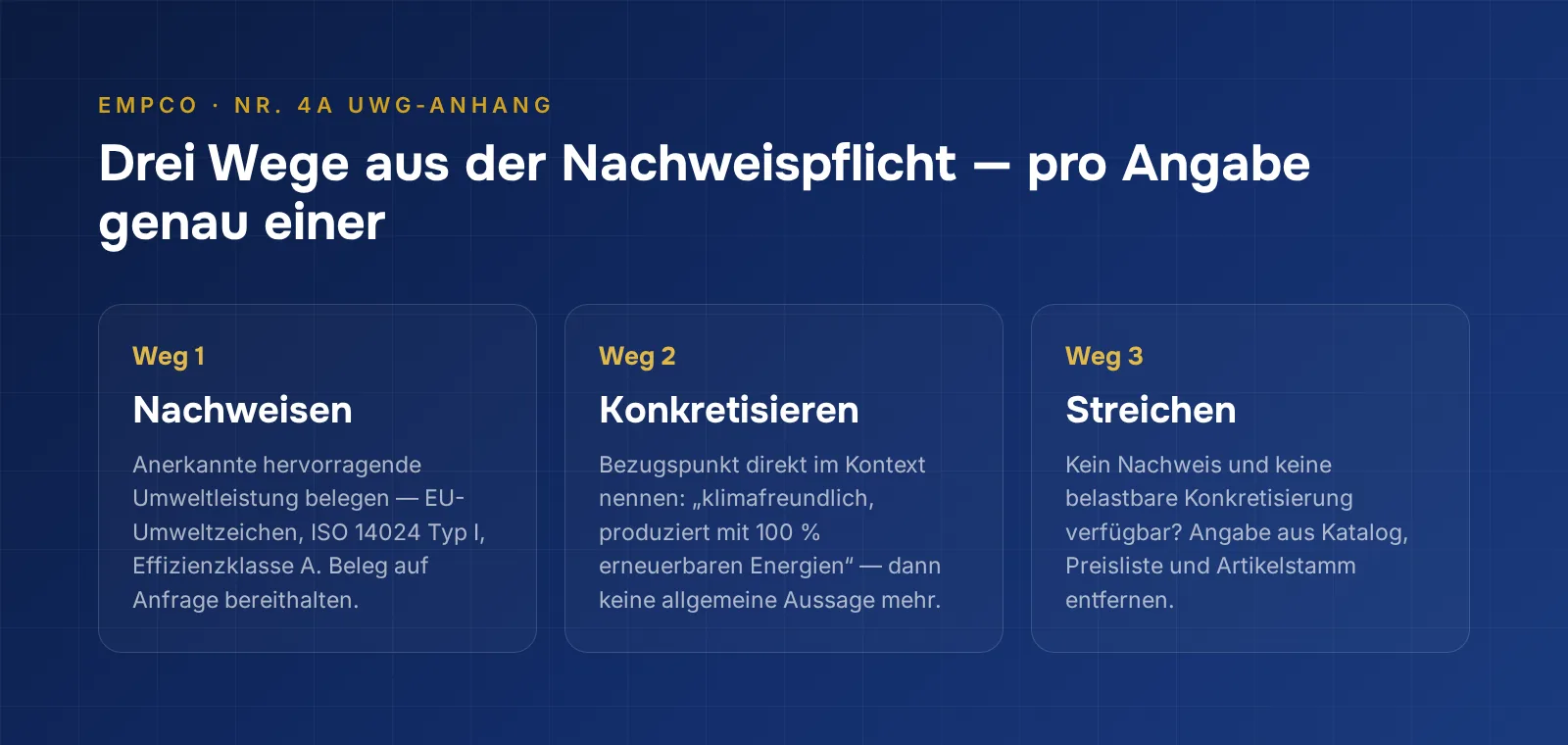
Exception 1 — proven top performance. Generic claims remain allowed if you can prove a “recognised excellent environmental performance”. It counts as recognised, for example, if it qualifies for the EU Ecolabel (Regulation 66/2010), is certified under DIN EN ISO 14024 Type I, or counts as top environmental performance under other Union law — the directive itself names efficiency class A as an example. The proof does not have to appear in the advertisement itself; it only has to be kept available on request.
Exception 2 — specification. The keyword loses its generic character when the reference point is disclosed directly in context. It then no longer falls under the proof requirement of No. 4a:
| Generic claim (proof required) | Specified claim (allowed, if true) |
|---|---|
| “climate-friendly” | “climate-friendly, produced using 100 % renewable energy” |
| “sustainable” | “sustainable because fully recyclable” |
| “energy-efficient” | “energy efficiency class A” (counts as recognised excellent environmental performance) |
For orientation, the keywords meant are: climate neutral, climate-friendly, environmentally friendly, eco-friendly, green, ecological, CO2-neutral, energy-efficient, biodegradable, bio-based. Whoever carries one of these words in a price list or shop needs either the proof or the context from September 27, 2026.
Who bears responsibility when manufacturer claims are passed on
The classic case in trade: the supplier delivers the product description, you adopt it into catalogue and shop, your customers order from it. From a competition law perspective, you advertise with every claim you use in your own materials — the origin “from the manufacturer” does not exonerate you. If you cannot substantiate the claim yourself, there are two ways: request the proof from the supplier and file it — or remove the claim, or specify it.
Frequently asked: does pointing to the manufacturer suffice?
The reference helps you obtain the evidence, but it does not change that it is you who makes the claim in your own catalogue. The proof must be available with you — where it comes from is secondary.
Practically, this means: an environmental claim is a field with proof obligations, exactly like the price. Newly added products need a fixed step in the process: claim yes or no, proof available yes or no, specified yes or no.
Practice check: three weeks are enough for the inventory
- Inventory. Collect all channels: catalogue PDFs, price lists, shop attributes, category descriptions, quote templates, product names. Run the keyword list above as a search list over your exports — that's an afternoon, not a project.
- Sort. Every finding gets one of three values: provable (obtain and file the proof), specifiable (request additional info from the supplier), or remove.
- Write to suppliers. One email is enough: “Which proof underlies the claim ‘biodegradable’ for item 4711?” — send it today, not on Sept 26.
- Anchor the process. Product onboarding gets the mandatory field “environmental claim?” with a proof rule. Otherwise the exercise repeats with the next supplier catalogue.
Maintain claims in one place instead of hunting across ten channels
The real effort is not the one-time clean-up but the maintenance from 2027 onwards. When a claim must be specified, it changes in the catalogue, the price list, the shop, and the quote template — four places, four chances for inconsistency. That's exactly why digital price lists with a central product master beat distributed documents: you change the description once, it rolls out to every customer shop and price list carrying the item. How such a B2B order portal feeds price lists and customer shops from one data stock is described here.
The same argument applies to the e-invoice mandate from 2027 — there, too, mandatory details live in the product master or nowhere at all. Whoever keeps their data central once turns regulatory deadlines into routine tasks instead of fire-fighting.
FAQ
Does the rule also apply to price lists and catalogues for business customers?
Yes. The provision of No. 4a of the UWG annex is formulated absolutely and covers generic environmental claims in commercial communication — catalogues and price lists count, even if they only go to business customers. There is no B2B exemption.
Do the proofs have to appear directly in the advertising?
No. The proof of the recognised excellent environmental performance does not have to be included in the advertisement itself — it only has to be kept available on request. “Available” means: documented with you, the advertiser, not requested from the supplier first.
From when exactly does this apply?
The EmpCo Directive must be transposed into national law by September 27, 2026; with the transposition, the new rules take effect. Whoever reviews their inventory now has three weeks of buffer — and a clean process for every item newly added to the range afterwards.
If you want to maintain your product data centrally — price lists, catalogues, and customer shops from one stock — take a look at a demo of Kontorly. Kontorly is a German B2B e-commerce platform (SaaS) for online shops with tiered prices, customer groups, and direct orders from business customers. Made in Germany, from Hamburg.
Kontorly Editorial Team
This article was written by the Kontorly editorial team. We cover B2B commerce, shop systems and digital processes — editorially independent, with insights from building our platform every day.
Ready to launch your B2B shop?
Kontorly brings tiered pricing, customer groups and e-invoices out-of-the-box. Set up in minutes.
Start for free