

Why B2B E-Commerce Projects Fail: 5 Causes
Why B2B shop projects chronically run over budget: 5 causes of failure from scope creep to ERP — and what the platform approach does differently.
B2B Commerce · Project Reality
Selling to businesscustomers isnot an IT project.
Why B2B e-commerce projects fail — five causes, from scope creep to ERP integration.
The Project
Month 18 · budget × 2
The Platform
B2B shop,
pre-configured
Tiered prices · customer groups · e-invoices
Live in days
In demo conversations, we keep hearing the same story, shortly before companies come to us: two years ago, the decision was made to digitalise sales to business customers. First came the specification document — 40 pages. Then the agency, then the tax advisor, then three change requests per month. Today the shop is "almost finished", the budget exceeded for the second time — and the business customers still order by phone with the PDF price list from the website.
Why do B2B e-commerce projects fail so often?
In short: B2B e-commerce projects rarely fail on technology. They fail because they are planned as a one-off IT project with an end date — even though a B2B shop is a sales channel that wants to be operated from day one. Five causes carry the lion's share: endless project scope, bolted-together systems, underestimated ERP integration, no operator — and niche requirements no standard product was built for.
The pattern: the project that never finishes
The classic starts honestly. Management wants to do it properly, no botch job: individual solution, serious agency, own design. The quote states twelve to eighteen months of implementation and a budget that quickly reaches five to six figures — plus maintenance running from day one after completion.
The trade press has found its own word for the result. In its report on the e-commerce trends 2026, the Hamburg agency Medienwerft speaks of "project horror": B2B portals as mammoth undertakings that run longer than some products stay on the market. Their second observation is the interesting one — the horror is fading because companies increasingly procure portals as platforms instead of awarding them as construction projects.
Anyone who wants to know all paths before committing to one finds the full cost calculation here — from the agency solution to the platform.
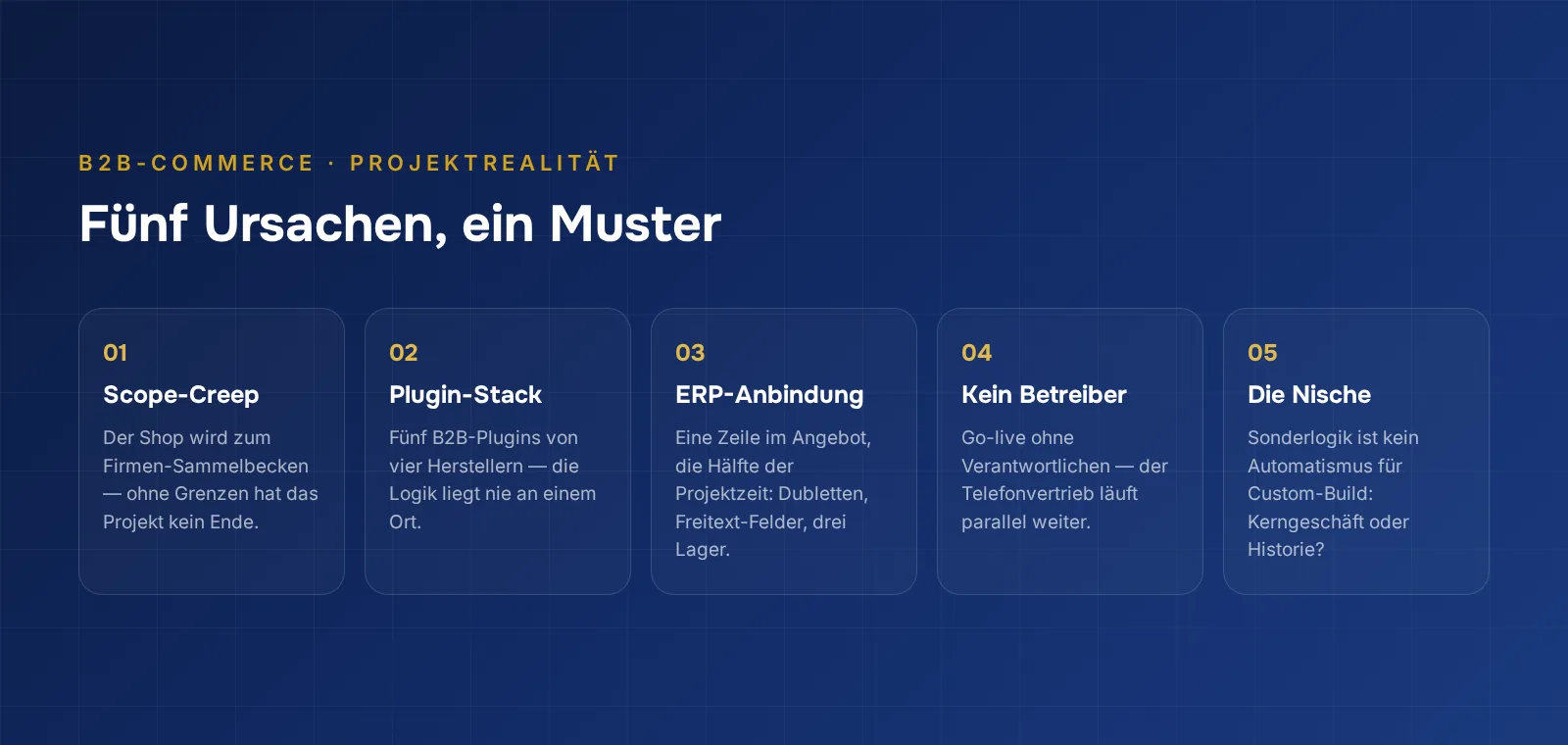
Cause 1: Scope creep — the shop becomes the company's catch-all
A B2B shop needs customer groups, tiered prices, and an invoicing logic the tax office accepts. But in the first project meeting, marketing wants the new CMS on top, management the reporting, sales the CRM interface — and in the end the thing is supposed to replace the field service app too.
Each of these demands is reasonable on its own. Together, it is no longer a shop project but a digitalisation strategy without prioritisation — distributed across an agency that bills by the hour. The project has no end because its boundaries were never defined. The decisive question is missing from every specification document we get to see: What must the shop be able to do on day one — and what explicitly not?
Cause 2: The bolted-together stack
Whoever doesn't build individually, assembles. A WordPress with WooCommerce, plus five B2B plugins from four vendors: customer groups here, tiered prices there, invoice dispatch as an extra. Every requirement brings another third-party product with its own release cycle into the shop — and the B2B logic never lives in one place, but in the wiring. How this tips over in detail, we took apart in the plugin trap.
And Shopify is no escape from this cause — just a more expensive variant of it. Whoever takes B2B seriously there ends up with Shopify Plus, with apps for tiered prices and customer groups, and usually with an agency holding it all together. Why that gets more expensive than you think is shown by the maths in detail.
Cause 3: ERP integration is one line in the quote — and half the project time
The specification says: "Interface to the ERP system." Sounds like a week of work. Then reality begins: a product master with a thousand duplicates, price conditions maintained as free-text fields in the ERP, stock levels living in three places. Integration is the part of the project nobody wants to own at kickoff — and on which it is ultimately decided financially.
Common question: Does a B2B shop work without ERP integration?
For the start: yes. Many companies go live with manually maintained items and add the integration later. But the higher the order volume climbs, the faster manual order transfer becomes the new bottleneck — the shop then replaces a phone with a data field. So the question is not whether but when you integrate — and whether your system provides interfaces for it, or whether change request number 14 gets written.
Cause 4: Nobody operates the shop
Go-live is not the goal, but the beginning. Maintaining items, updating prices, writing content, sharpening ordering processes, handling returns — a sales channel is a living system.
In many companies, what always happens after launch happens when responsibility is carried "jointly by everyone": nothing. Phone sales continue in parallel because they work well. Business customers keep ordering from a person, because the person answers faster than the shop search. After a year, the ROI is red and the project counts as failed — even though the shop runs flawlessly from a technical standpoint. It didn't stumble over the code, but over the fact that it was nobody's job in the company.
Cause 5: The niche no standard knows
Some requirements are genuinely odd — and deserve respect instead of a standard solution. Automotive parts trade needs vehicle-based search: parts by model, year of manufacture, engine. Machine building maintains spare parts catalogues by serial numbers of machines running in the field for twenty years. Forcing such logics into a standard system ends in one of two extremes: the project explodes — or the shop never fits the business in the first place.
The honest answer to this cause: niche is no automatic case for a custom build. The question is whether your peculiarity concerns your core business (then individual development is worth it) or only your history (then you're paying for habit). And what a customisation really costs over the runtime is in the cost calculation.
The direct comparison
| Custom build project | Platform approach | |
|---|---|---|
| Time to go live | 12–18 months | Days to weeks |
| Cost frame | five to six figures, plus ongoing maintenance | monthly licence, from €249/month at Kontorly |
| B2B core (tiers, customer groups, e-invoices) | developed and accepted | natively included |
| Changes after launch | change request, quote, deadline | configuration by you |
| Operation | agency maintenance contract | platform runs the technology, you run the channel |
When your own project is still right
This criticism is not fundamental opposition. An individual project is a sound decision if your business is genuinely odd — processes no standard product wants to map. If you have an IT department that can operate a system and keep developing it. If integration into the existing landscape matters more than anything and the budget is there.
Then the custom build is not a bad decision. Just an expensive one — and it should be made consciously, with open eyes about five years of operating costs. What doesn't work is the variant we see most often: starting an individual project because as a mid-sized company you "basically owe it to yourself". That's not a criterion. That's tradition with an invoice.
What the platform approach does differently
Against each of the five causes, the platform approach sets the same remedy: the scope is fixed because the channel is finished. There is no plugin stack because the B2B logic sits in the core. Interfaces are part of the product instead of a change request. And operation is shared — the platform carries the technology, you carry the business.
The market is moving exactly there: self-service ordering and clean system integration became the standard in 2026 — expected by business customers who know their buying experience from private consumption.
Our position is clear: selling to business customers is not an IT project. Kontorly is a German B2B e-commerce platform (SaaS) for online shops with tiered prices, customer groups, and direct orders by business customers. Made in Germany, from Hamburg.
Whether that fits your business, you'll see in 30 minutes: Book a demo — costs nothing, commits you to nothing.
How long does introducing a B2B online shop take?
As a project: expect twelve to eighteen months to go-live. As a platform: days to weeks, depending on how quickly your items and prices are ready. The difference is not the technology — it's the path there.
Is a B2B shop worth it with 20 regular customers?
Do the maths honestly: 20 customers whose orders happen by phone today cost your team hours nobody bills. A shop that handles these orders in self-service pays off through time gained — not through new customers. The 20 regulars are the minimal example, not the limit.
What happens to our special conditions per customer?
That's exactly what customer groups and tiered prices in the core of the system are for: the logic that today lives in Excel and in sales' heads is set up once and then applies to every order. Special conditions are not an exception in B2B — they are the norm everything revolves around.
Sources: Medienwerft, E-Commerce Trends 2026 (industry report — "From project horror to scalable platform") · Sana Commerce, B2B E-Commerce Trends 2026 (self-service and ERP integration as central success factors). As of: August 2026 — both captured via the research pipeline on 24.08.2026.
Kontorly Editorial Team
This article was written by the Kontorly editorial team. We cover B2B commerce, shop systems and digital processes — editorially independent, with insights from building our platform every day.
Ready to launch your B2B shop?
Kontorly brings tiered pricing, customer groups and e-invoices out-of-the-box. Set up in minutes.
Start for free