

B2B E-Commerce Trends 2026: What Really Matters
B2B e-commerce trends 2026: self-service, ERP integration, and buyer expectations — the 3 trends with data, and what they really mean for merchants.
B2B Commerce · Outlook
B2B E-Commerce Trends 2026
Self-service, ERP integration, buyer expectations: the three trends actually changing trade.
Trend 1
Self-Service
Buyers order on their own — routine purchases without sales.
Trend 2
ERP Integration
Excel islands were yesterday — data flows become standard.
Trend 3
Buyer Expectations
Availability, transparency, speed — the bar is B2C.
Every January, every B2B software vendor publishes their trends for the year — and, surprisingly, the most important trend is always exactly the product they sell. For this article, we set out to keep only the trends that survive a reality check in the German Mittelstand: data from several independent sources, measurable effects, and an answer to the question of what a business with 20, 40, or 100 business customers can actually do with it. Three remain.
Which B2B trends really matter in 2026?
Three: self-service (buyers order for themselves — digital handling becomes an expectation, not a bonus), ERP integration as the standard (island solutions and Excel silos increasingly become visible brakes), and sharpened buyer expectations (availability, transparency, ready to ship — the bar is set by the B2C experience). None of the three is new. What's new in 2026 is that they tip from "we'll get to it eventually" into decision-pressure mode — evidenced by buyer studies and the KPIs of shops that have already made the switch.
Trend 1: Self-service — buyers want to shop like they do in private life
The most striking finding of current buyer analyses is unspectacular: B2B buyers are people who order digitally in their private lives every evening as a matter of course. Sana Commerce's trend analysis for 2026 sees buyer expectations as the central driver of B2B commerce — not vendor technology.
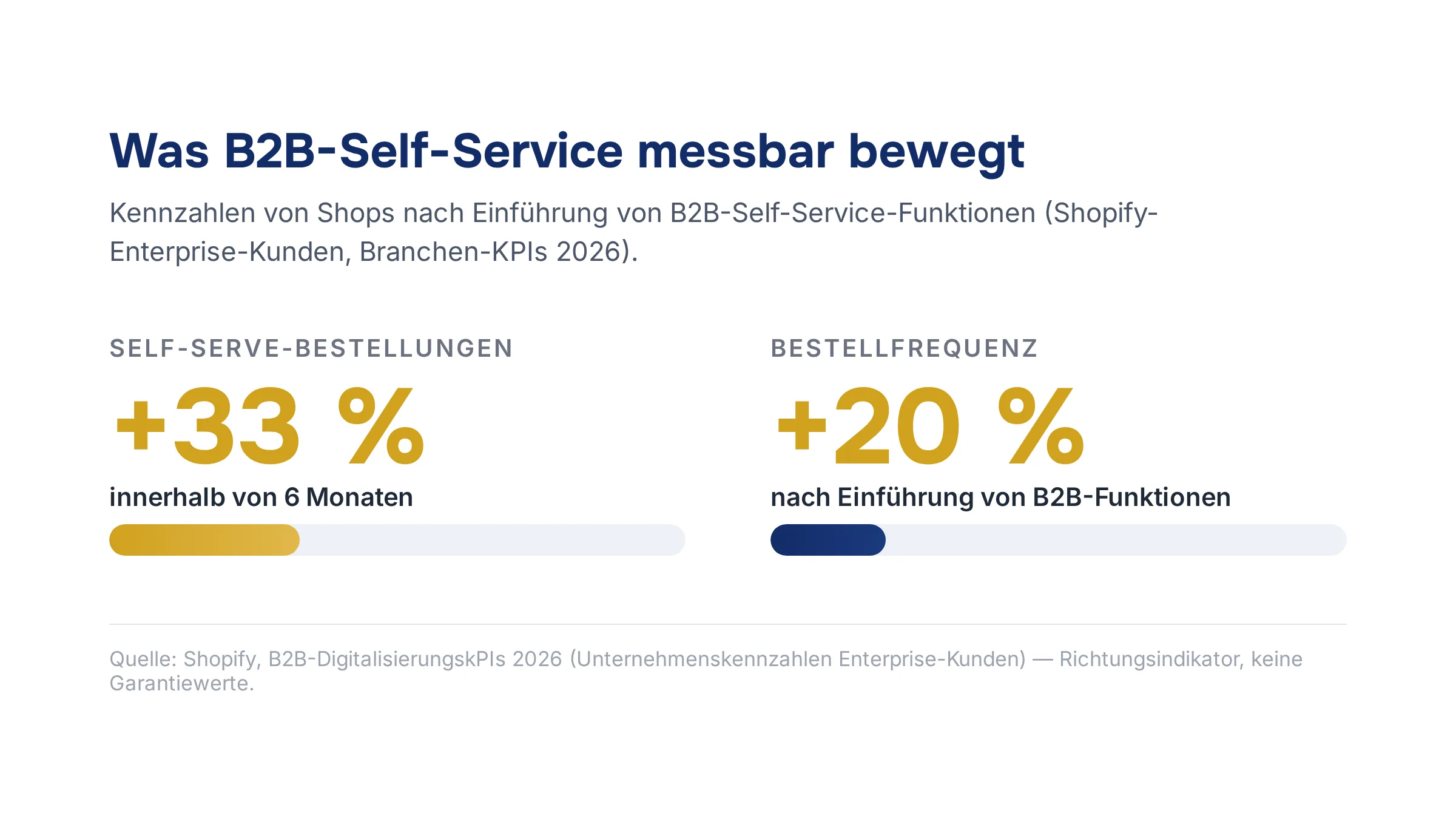
It becomes concretely measurable in shops that have introduced B2B self-service. Shopify publishes figures for its enterprise customers that serve as a directional indicator, independent of the specific system: 33 % more self-serve orders within six months of introduction and up to 20 % higher order frequency — because orders that used to require an email and two phone calls now take two minutes. Anyone who had to print out the order form every morning orders less often. Friction eats frequency.
Three things are required for self-service to work in B2B — and all three distinguish it from a B2C shop: first, prices the buyer can actually see (individual prices per customer instead of guest prices); second, order history and reordering in one click; third, an ordering path without registration friction for every employee of the customer. What such an ordering path looks like in detail is broken down in B2B Order Portal: Features & Operations Compared.
Common question: Does self-service cost my sales team the customer relationship?
The opposite. The routine purchase migrates — exactly the orders where a call was pure effort. What remains is contact that is genuinely contact: assortment questions, special terms, problems. Sales time is getting more expensive; burning it on reorders is the most expensive form of customer loyalty.
Trend 2: ERP integration becomes the standard — the end of Excel island
The second trend is the flip side of the first. When orders come in digitally, they need a digital path onward — into the warehouse, accounting, replenishment. Shopware's B2B Kompass 2026 diagnoses the sore point of many companies here: established digital channels, but fragmented systems and island solutions that slow down everyday B2B. The report describes exactly what we hear in consulting conversations: the shop runs, but every order is typed in once more — into Excel, into the ERP, into the merchandise management system.
The trend statement for 2026 is not "everyone needs an ERP integration project." It is harsher: integration becomes a purchase criterion. A new shop solution that doesn't pass orders on cleanly is no longer seriously selectable in 2026 — no matter how pretty the frontend is. Anyone choosing today asks about interfaces and data flows first, and about design after.
For smaller merchants, this means two things. First: the integration need shrinks when one system handles the core processes completely — order, invoice, customer prices in one place instead of three. Second: the price of "we'll deal with it later" rises, because data volumes grow. What is a quick motion at 10 orders a day is a half-day job at 50.
Trend 3: Buyer expectations — availability, transparency, speed
The third trend is the sum of the first two, but it deserves its own attention because it is the most underestimated. McKinsey's B2B Pulse studies have shown the same pattern for years: buyers spread their time across many channels and choose the path of least resistance. Anyone who can't be found, doesn't deliver, or doesn't make transparent what arrives when — is not punished by a complaint, but by silence. The buyer simply orders elsewhere.
What is concretely expected in 2026:
- Visible availability: stock level on the product, delivery time before purchase — not after the order confirmation upon request
- Price transparency: your own price after login, without having to request a PDF price list
- Real-time status: from "ordered" to "shipped" without calling sales
- One contact person when it burns: self-service for the routine, humans for the exception
Note the order: the human comes last — but they do come. The logic of purchasing in 2026 is hybrid: digital where digital is better, personal where personal is better. Anyone offering only one of the two loses half.

What this means for merchants — three honest sentences
First: Not everyone needs everything. A business with 15 regular customers and phone ordering is not an urgent digitization candidate — as long as the buyers of those 15 customers don't start ordering elsewhere. The pressure doesn't come from the calendar, but from buyer behavior. The honest middle ground: check every two years what your own customers expect today — and which of those things the shop doesn't deliver.
Second: The base catalog before the trend topic. Self-service only works with the right foundations — individual prices per customer, order history, clear availability. That is unglamorous and decisive. Anyone thinking about AI features in B2B before the pricing logic is right is renovating the roof over a missing foundation.
Third: The cost of doing nothing is invisible but real. Lost orders don't show up in any statistic. The 20 % order frequency from the Shopify KPIs works in reverse too: shops without self-service forgo exactly that potential — silently. What a functioning B2B shop costs and what it brings is calculated in What Does a B2B Online Shop Cost?.
Common question: Do I need AI in my B2B shop in 2026 already?
For the core of the purchasing process: no. The 2026 trends revolve around self-service, integration, and expectations — not generated product texts. AI helps at the margins (suggestions, search, service answers), but no buyer switches suppliers because of an AI feature. Only once the basics are in place is AI an amplifier — not before.
The trend behind the trends
All three trends converge on the same point: B2B commerce adapts to buying behavior, not the other way around. Buyers are people with B2C expectations and B2B requirements — individual prices, order history, invoice on account. Systems that bring both together win the dance in 2026. Systems that copy B2C and bolt B2B on as a plugin lose.
If at this point you're wondering what such a foundation looks like — we write about it here regularly. Kontorly is a German B2B e-commerce platform (SaaS) for online shops with tiered pricing, customer groups, and direct ordering by business customers. Made in Germany, from Hamburg. If you want to be notified about new articles on B2B trends and systems, subscribe to the newsletter.
Kontorly Editorial Team
This article was written by the Kontorly editorial team. We cover B2B commerce, shop systems and digital processes — editorially independent, with insights from building our platform every day.
Ready to launch your B2B shop?
Kontorly brings tiered pricing, customer groups and e-invoices out-of-the-box. Set up in minutes.
Start for free